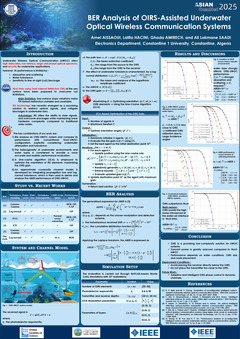
Optical intelligent reflecting surfaces (OIRSs) represent a paradigm shift in wireless communications by reconfiguring the propagation environment of optical waves. In the context of underwater optical wireless communication (UWOC), OIRS technology emerges as a promising solution to overcome severe channel impairments caused by obstacles. This paper investigates the performance gains achieved by integrating OIRSs into UWOC systems. Closed-form expressions for the probability density function (PDF), cumulative distribution function (CDF), and average bit error rate (ABER) are derived using the Laplace transform and Fox’s H-function, while accounting for underwater attenuation and turbulence. The numerical results highlight the impact of key parameters, including communication distance, source depth, type of water, and the number of OIRS elements. The findings demonstrate that OIRSs significantly improve the reliability and efficiency of UWOC systems.
